This tech support training video is hilarious (also available at http://www.thewebsiteisdown.com/). Who says tech and marketing people can't communicate?
Showing posts with label technology. Show all posts
Showing posts with label technology. Show all posts
Monday, June 30, 2008


Sunday, January 13, 2008
Google Analytics
As this blog nears its first birthday, I thought I'd share some of the Google Analytics statistics from the last 12 months. Although Google Analytics is far from perfect, as it misses all the RSS readers, and anyone like me who runs NoScript, it does provide a pretty graphical view of traffic.
The visitor overview below shows that throughout the year we're averaging about 10 visitors a day, with the obvious spike in interest after Rosalie's birth in July.

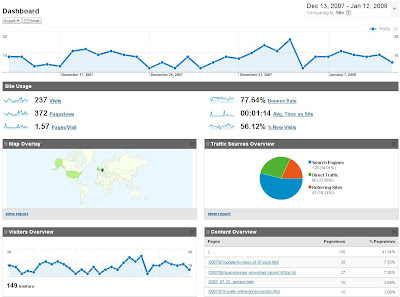
The dashboard view below for the last month bears this out with some interesting stats on Pages/Visit, average time on site etc. Of course, the accuracy of these figures are limited by the manner in which they are gathered - for example a single visit may be read for a while, but will always be recorded as 0 seconds if the next page is off-site, but these are standard deficiencies in web analytics.
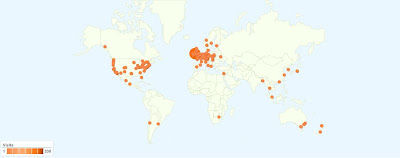
One graph I always like to check out is the Map Overlay, below the city view is shown. This blog has been viewed on all continents, and from 52 countries. A warm welcome to all readers in Uzbekistan, Bangladesh, Chile, United Arab Emirates and Senegal. Just why there was a visit from Quantico, Virginia, USA is still a mystery to me - what interest could the FBI, Marine Corps or the Drug Enforcement Administration have in me? Surely not my harsh stance on copy protection mechanisms for Digital Media :-)
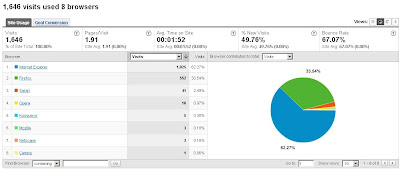
On a lighter note, it's fun to see what browsers visitors to this site are using. Internet Exploder remains the top weapon of mass distraction, but at just over 33%, Firefox is gaining ground.
BTW, it's not depicted here but the OS split is 94%, 5% and 1% for Windows, Mac and Linux respectively. There's still some work to do for Linux on the desktop ;-)
The visitor overview below shows that throughout the year we're averaging about 10 visitors a day, with the obvious spike in interest after Rosalie's birth in July.
The dashboard view below for the last month bears this out with some interesting stats on Pages/Visit, average time on site etc. Of course, the accuracy of these figures are limited by the manner in which they are gathered - for example a single visit may be read for a while, but will always be recorded as 0 seconds if the next page is off-site, but these are standard deficiencies in web analytics.
One graph I always like to check out is the Map Overlay, below the city view is shown. This blog has been viewed on all continents, and from 52 countries. A warm welcome to all readers in Uzbekistan, Bangladesh, Chile, United Arab Emirates and Senegal. Just why there was a visit from Quantico, Virginia, USA is still a mystery to me - what interest could the FBI, Marine Corps or the Drug Enforcement Administration have in me? Surely not my harsh stance on copy protection mechanisms for Digital Media :-)
On a lighter note, it's fun to see what browsers visitors to this site are using. Internet Exploder remains the top weapon of mass distraction, but at just over 33%, Firefox is gaining ground.
BTW, it's not depicted here but the OS split is 94%, 5% and 1% for Windows, Mac and Linux respectively. There's still some work to do for Linux on the desktop ;-)
Wednesday, January 09, 2008
Secure your USB Stick

If like me you like to carry sensitive data around on a USB stick you'll know the following two facts:
- It's incredibly useful to have your data with you.
- It's only a matter of time before you misplace the USB stick.
So I was glad to hear on the latest Security Now about omziff, a little non-installing app which can be used to encrypt and decrypt files. Simply download the exe, encrypt your sensitive data, pop the encrypted file plus the omziff.exe file onto your USB stick and you're good to go.
The feature set is not large, but what's there is done well. All the major modern open encryption standards are covered (e.g. Blowfish, IDEA, Rijndael, Twofish), and make no mistake, encryption with one of these algorithms is safe.
An extra feature which I really like is the shredder, which eliminates your sensitive files from the host machine after use, by writing random characters over the disk space multiple times. This is a program to help you sleep at night :-)
Friday, January 04, 2008
Apps for a new machine
As mentioned in the previous post, I just got my hands on a new Lenovo laptop courtesy of my new employer, and I thought I'd post details on my priority apps that I installed asap. And to you, Mr Concerned-IT-Helpdesk-Guy, please look away now...
1. Firefox: Unlike 62.84% of visitors to this site, I do not like to use Internet Exploder for browsing. I appreciate that version 7 is improved, and it's not as unsafe as it once was, but I simply prefer the Firefox experience. BTW, extensions NoScript, Foxmarks, Googlepedia, PasswordMaker, Cookiesafe, GSpace and GUtil are as important to me as the original program.
2. Google Pack: A bit of a cheat this, as it includes many must-haves such as Adobe Reader, Google Earth, Picasa, Skype, Google Photos Screensaver, etc. A no-brainer, though I don't take the browser toolbar or the spyware stuff, as I prefer other options for those.
3. iTunes: I listen to a lot of podcasts, and it's simply the best PC experience to doing so. One downer is the migration of iTunes playlists and account from one computer to another - not as nice as it should be.
4. PureText: This little app is just so elegant, it's no wonder Microsoft never thought of it themselves. Don't you mostly prefer just to cut and paste text, and not the surrounding formatting junk? Especially between Office apps, this is great. Cannot recommend highly enough.
5. FreePDF XP: The kind folks in the IT department included a PDF generator in my software load, but it doesn't measure up. FreePDF simply works in a simple, intuitive and useful way.
There are other apps which I'll install over the coming weeks and months, but these are to me the important ones. If you know of further great apps and/or Firefox extensions, please let me know in the comments.
1. Firefox: Unlike 62.84% of visitors to this site, I do not like to use Internet Exploder for browsing. I appreciate that version 7 is improved, and it's not as unsafe as it once was, but I simply prefer the Firefox experience. BTW, extensions NoScript, Foxmarks, Googlepedia, PasswordMaker, Cookiesafe, GSpace and GUtil are as important to me as the original program.
2. Google Pack: A bit of a cheat this, as it includes many must-haves such as Adobe Reader, Google Earth, Picasa, Skype, Google Photos Screensaver, etc. A no-brainer, though I don't take the browser toolbar or the spyware stuff, as I prefer other options for those.
3. iTunes: I listen to a lot of podcasts, and it's simply the best PC experience to doing so. One downer is the migration of iTunes playlists and account from one computer to another - not as nice as it should be.
4. PureText: This little app is just so elegant, it's no wonder Microsoft never thought of it themselves. Don't you mostly prefer just to cut and paste text, and not the surrounding formatting junk? Especially between Office apps, this is great. Cannot recommend highly enough.
5. FreePDF XP: The kind folks in the IT department included a PDF generator in my software load, but it doesn't measure up. FreePDF simply works in a simple, intuitive and useful way.
There are other apps which I'll install over the coming weeks and months, but these are to me the important ones. If you know of further great apps and/or Firefox extensions, please let me know in the comments.
Monday, October 15, 2007

Friday, October 05, 2007
People who create and sell mobile services don't actually use them (Shock!)
See here for the full story.
This definitely rings true with me, although more from an implementor of mobile services than an executive viewpoint ;-) I've been working on various mobile messaging and music services since 2003. Yet I don't use them regularly, for some or all of the following reasons:
Note - although I've not yet tried out the new GPS phones, I'm suspicious that there too a compromise in GPS usability will be noticeable compared to a pure GPS device. I have separate GPS devices for driving and walking, and I would be surprised if a single GPS device could optimise both use cases, never mind as an offshoot of a mobile phone.
"among the mobile operator, media player, content owner, developer and retailer execs in attendance, 56 percent said they employ mobile web services on a daily basis, but rarely if ever capitalize on mobile TV and music services."
This definitely rings true with me, although more from an implementor of mobile services than an executive viewpoint ;-) I've been working on various mobile messaging and music services since 2003. Yet I don't use them regularly, for some or all of the following reasons:
- Price: Why do I need to pay a mobile premium? Full Track Music delivered Over The Air for a 50-100% surcharge? No thanks. Ringtones are a notorious rip-off - up to 3 euros for a jingle I can manufacture myself for free. Even SMS and MMS, although comparitively inexpensive, make me angry because I know that the 15 cents per message is more than 20 times the network cost of transferring the message. I know I'm being suckered, and that modifies my consumption behavour.
- User Experience: Mostly sucks. Small screen, awkward typing, tinny sound, poor video. These are part and parcel of using a mobile phone for sending messages, taking pictures, and playing audiovisual media.
- Better alternatives: For messaging, why not use the laptop? Sure it's less spontaneous, but the quality improves (how many times have you read an unconsidered, poorly written, one-line email, and then right below the reason is proudly presented - "sent from my wireless handheld"). If you want to take a picture, why not use a decent camera? For music and video, any digital player is going to beat the available phones for the simple use case of playing a song. Who says that we only want 1 gadget, when 2 use cases are distinct enough to warrant 2 gadgets?
Note - although I've not yet tried out the new GPS phones, I'm suspicious that there too a compromise in GPS usability will be noticeable compared to a pure GPS device. I have separate GPS devices for driving and walking, and I would be surprised if a single GPS device could optimise both use cases, never mind as an offshoot of a mobile phone.
Thursday, August 23, 2007
GEZ Censorship
Those of you who live as I do in Germany will have had occasion to be upset by the Gebühreneinzugszentrale (GEZ). These people are officially there to ensure that everyone pays their licence fees, but are known for their use of tactics more appropriate to the Stasi.
I was shocked to see this article in Golem, describing how the GEZ want to take akademie.de's Tips and Tricks section on GEZ offline. They have threatened legal action for use of false terms like "GEZ-Gebühren", "PC-Gebühr", "Gebührenfahnder", "GEZ-Anmeldung" or "GEZ-Abmeldung". This is laughable, as these terms are in common use, and not as perjorative as the GEZ deserves.
To be clear - Akademie.de have been offering legal and legitimate advice to protect consumers from overpaying. They have now taken down this legitimate content, awaiting a legal review. See their current site explaining the takedown.
My suggestion to those who care about defeating censorship is to take advantage of Google's caching function to locate these GEZ tips, and keep them in the public domain. For example:
This may seem like a trivial example, but if German authorities can censor this sort of material, it won't take long before they take more examples from the Chinese government.
I was shocked to see this article in Golem, describing how the GEZ want to take akademie.de's Tips and Tricks section on GEZ offline. They have threatened legal action for use of false terms like "GEZ-Gebühren", "PC-Gebühr", "Gebührenfahnder", "GEZ-Anmeldung" or "GEZ-Abmeldung". This is laughable, as these terms are in common use, and not as perjorative as the GEZ deserves.
To be clear - Akademie.de have been offering legal and legitimate advice to protect consumers from overpaying. They have now taken down this legitimate content, awaiting a legal review. See their current site explaining the takedown.
My suggestion to those who care about defeating censorship is to take advantage of Google's caching function to locate these GEZ tips, and keep them in the public domain. For example:
This may seem like a trivial example, but if German authorities can censor this sort of material, it won't take long before they take more examples from the Chinese government.
Wednesday, August 22, 2007
Blogmusik is now Deezer
One music service which I've been impressed by recently is France-based BlogMusik. The design is funky, there's a fair amount of music available, and it's pretty damn fast, especially considering the graphics they're using on the site.
My assumption was that the site was bordering on illegal, and would be closed down soon enough. Today I was pleasantly surprised to find out on Techcrunch that BlogMusik is renaming to Deezer as part of a transition to legitimacy.
Deezer has a charming widget feature, similar to those from gbox and last.fm, which I previously blogged about here and here respectively. Below is the widget for a playlist which I put together (note - this may not display in an RSS Reader, click through to the blog itself). The great thing is that you can play this list as is, no 30-second previews or DRM.

Alternatively, you can share individual songs, via IM, or embedded HTML as below.
Another nice feature is the Smart Playlist, given a track, Deezer cycles through a playlist of tracks which are similar.
So how does Deezer make money? The streaming rights and bandwidth will doubtless come at a hefty price. Set against that will be some advertising revenue from banner ads, and a kick-back from iTunes (each song has an iTunes icon, so you can click through to buy). I doubt that they're currently covering their costs, but in the Web 2.0 world growth is much more important than revenue ;-)
I rate Deezer as a pretty good service, and I hope the impending legality won't kill the innovative charm they've displayed thus far.
My assumption was that the site was bordering on illegal, and would be closed down soon enough. Today I was pleasantly surprised to find out on Techcrunch that BlogMusik is renaming to Deezer as part of a transition to legitimacy.
Deezer has a charming widget feature, similar to those from gbox and last.fm, which I previously blogged about here and here respectively. Below is the widget for a playlist which I put together (note - this may not display in an RSS Reader, click through to the blog itself). The great thing is that you can play this list as is, no 30-second previews or DRM.
Alternatively, you can share individual songs, via IM, or embedded HTML as below.
Another nice feature is the Smart Playlist, given a track, Deezer cycles through a playlist of tracks which are similar.
So how does Deezer make money? The streaming rights and bandwidth will doubtless come at a hefty price. Set against that will be some advertising revenue from banner ads, and a kick-back from iTunes (each song has an iTunes icon, so you can click through to buy). I doubt that they're currently covering their costs, but in the Web 2.0 world growth is much more important than revenue ;-)
I rate Deezer as a pretty good service, and I hope the impending legality won't kill the innovative charm they've displayed thus far.
Wednesday, August 15, 2007
Comparison of gBox widget with Last.fm
After posting about the gBox service, I though I'd offer a visual comparison with a service I've been using for a while: last.fm. Below is my last.fm "recent tracks" widget, which also handily slides into Facebook.
I've got to say, my preference is very clearly for the last.fm app for its clean design. What do you think?
[Update: If like me you use Google Reader, you'll not see the widget. Click through to website to see this post in it's full glory]
I've got to say, my preference is very clearly for the last.fm app for its clean design. What do you think?
[Update: If like me you use Google Reader, you'll not see the widget. Click through to website to see this post in it's full glory]
gBox
After the news that Universal is experimenting with DRM-free music downloads, I thought I'd have a look at one of the platforms where this will be available: gBox.
Opening www.gbox.com in Firefox is not (yet) possible - though using the IETab extension works. Once the user agent is sorted, the interface is fairly attractive and responsive, although search and browse are currently pretty poor. The teasered songs were not very extensive, and the alphabetical list of artists is far too large to skim through (give it a go yourself)
Although gbox is partnering with Google on this, the "g" does not denote Google, rather insinuates that the site is used for "gifts". The current setup is essentially a glorified music wishlist. Purchasing music for yourself is certainly permitted, but seems to be an add-on functionality!
Once registered and logged in, I was able to create this list of desired tracks:


The HTML code snippet may be simply cut and pasted anywhere (although it doesn't fit in the right sidebar on this template). Now readers of this blog are free to give me music pressies :-)
There seem to me to be a few usability and compatibility problems with this service, we'll see how long it takes to get them sorted. However the wishlist widget is pretty funky, and may gain traction in the wild.
My concern is that by ruling out Apple as a partner for this experiment, Universal are losing a control factor, namely the comparison of DRM and DRM-free sales where usability is the same high quality. We'll see how this turns out.
[Update: If like me you use Google Reader, you'll not see the widget. Click through to website to see this post in it's full glory]
Opening www.gbox.com in Firefox is not (yet) possible - though using the IETab extension works. Once the user agent is sorted, the interface is fairly attractive and responsive, although search and browse are currently pretty poor. The teasered songs were not very extensive, and the alphabetical list of artists is far too large to skim through (give it a go yourself)
Although gbox is partnering with Google on this, the "g" does not denote Google, rather insinuates that the site is used for "gifts". The current setup is essentially a glorified music wishlist. Purchasing music for yourself is certainly permitted, but seems to be an add-on functionality!
Once registered and logged in, I was able to create this list of desired tracks:
The HTML code snippet may be simply cut and pasted anywhere (although it doesn't fit in the right sidebar on this template). Now readers of this blog are free to give me music pressies :-)
There seem to me to be a few usability and compatibility problems with this service, we'll see how long it takes to get them sorted. However the wishlist widget is pretty funky, and may gain traction in the wild.
My concern is that by ruling out Apple as a partner for this experiment, Universal are losing a control factor, namely the comparison of DRM and DRM-free sales where usability is the same high quality. We'll see how this turns out.
[Update: If like me you use Google Reader, you'll not see the widget. Click through to website to see this post in it's full glory]
Thursday, July 12, 2007
Cory Doctorow's take on DRM legislation
The venerable EFF old hand Cory Doctorow has written a long and interesting expose of the back-room dealing which goes into DRM governance and legislation. He quotes Otto von Bismarck (not a known supporter of open government): "Laws are like sausages, it is better not to see them being made."
I have yet to see a situation in which legislation and technology mix well. Too often the legislators are either out of their depth in understanding the technical details, or just plain corrupt. Can anyone think of another reason for the following governmental decisions? (my best guess in brackets):
Any other guessed causes? Feel free to comment.
I have yet to see a situation in which legislation and technology mix well. Too often the legislators are either out of their depth in understanding the technical details, or just plain corrupt. Can anyone think of another reason for the following governmental decisions? (my best guess in brackets):
- Ireland's RFID passport (Incompetence)
- Germany's Bundestrojaner (Incompetence mixed with Ideology)
- The US's Digital Millennium Copyright Act (Corruption)
Any other guessed causes? Feel free to comment.
Wednesday, June 27, 2007
The great Google Mail German Shutdown debacle
There have been several articles in recent days (e.g. VNUNet, Secure Computing and Heise) about Google's threat to close down its German email service, should the Bundestag implement new data retentention laws. Google is normally keen to retain all info about our digital lives, in order to better target advertising, yet in this instance they're saying no to state supervision. So what is all the fuss about?
The best overview I've found to this is on Spiegel (in German). The issue is critical, and not just for ISPs. In general, the aim is to log by default as much addressing info as possible for digital communication: email, VOIP, SMS,... An example of the extent is that MNOs will be required to save details of your cell location while you are calling and texting! The fact that it is illegal to save the content of the email, SMS, whatever, is only a partial reprieve, because the addressees, subject line, sending IP address, etc. already provides an unhealthy indication of message content and intent.
Although ostensibly a tool for the state authorities to monitor terrorism (come on, what terrorist is going to register his name and address, this is only going to affect honest people) the data once saved will doubtless be nirvana for the litigation-minded content industry, eager to know who's been surfing where.
Of course the ISPs and MNOs don't want to go along with this, as it raises their operations costs and scares away their customers. It's also highly improbable that they would be able to implement the technical changes required by the proposed date of 01.01.2008.
This legislation is still in draft form, and I encourage all respecters of privacy to visit this site (unfortunately only in German) and send a letter to your Bundestagsabgeordnete.
Footnote: As I'm geo-located in Germany with a gmail.com address, I'm still not sure whether this would affect my email. I'm fairly sure that I can connect to gmail via a proxy, but I'm hoping it won't come that far...
Update:
See also this post on PaidContent.org, with quotes from Google's global privacy counsel Peter Fleischer.
The best overview I've found to this is on Spiegel (in German). The issue is critical, and not just for ISPs. In general, the aim is to log by default as much addressing info as possible for digital communication: email, VOIP, SMS,... An example of the extent is that MNOs will be required to save details of your cell location while you are calling and texting! The fact that it is illegal to save the content of the email, SMS, whatever, is only a partial reprieve, because the addressees, subject line, sending IP address, etc. already provides an unhealthy indication of message content and intent.
Although ostensibly a tool for the state authorities to monitor terrorism (come on, what terrorist is going to register his name and address, this is only going to affect honest people) the data once saved will doubtless be nirvana for the litigation-minded content industry, eager to know who's been surfing where.
Of course the ISPs and MNOs don't want to go along with this, as it raises their operations costs and scares away their customers. It's also highly improbable that they would be able to implement the technical changes required by the proposed date of 01.01.2008.
This legislation is still in draft form, and I encourage all respecters of privacy to visit this site (unfortunately only in German) and send a letter to your Bundestagsabgeordnete.
Footnote: As I'm geo-located in Germany with a gmail.com address, I'm still not sure whether this would affect my email. I'm fairly sure that I can connect to gmail via a proxy, but I'm hoping it won't come that far...
Powered by ScribeFire.
Update:
See also this post on PaidContent.org, with quotes from Google's global privacy counsel Peter Fleischer.
Monday, June 25, 2007
Entertainment industry encourages piracy
The DVD Copy Control Association want to render DVD ripping impossible, according to the Register. Allegedly, they are doing this to prevent piracy. However the result is likely be exactly the opposite.
To see why this is the case, consider the efficacy of copy control mechanisms so far. They do not work. Every DRM system requires an encryption scheme and a licence key. Most modern encryption schemes are so advanced that with a sufficient key-length, it is very unlikely to be cracked by brute force. No-one is going to break AES-256 in order to watch Die Hard. They don't need to, because the key must be available in the user's system, and key security is always a weak link. Ironically the DRM for DVDs, CSS, is so weak that both encryption and key-finding attacks work just fine.
The current proposal to strengthen the (badly broken) CSS system is as follows:
Sound robust? Not a bit. Programs like DeCSS remove the CSS crud layer, leaving the file in the clear. There is nothing to stop it playing.
The desired effect may be to make the physical reproduction of discs more difficult, i.e. necessitating CloneDVD or similar. However the serious pirates are already well equipped, they can make 1:1 copies without effort.
So, who is affected by this proposal? The normal consumer who is not aware of DVD decryption tools. S/he will be unable to make backups of DVDs bought via legal channels, and will therefore look for alternatives. My expectation is that this will drive average consumers to seek out non-CSSed physical discs, probably directly per mail-order from Malaysia.
My counter-proposal to the entertainment industry would be to stop considering your customers to be either criminals or suckers, and start to satisfy their needs. Drop all DRM efforts, and concentrate on cultivating the consumers who are willing to pay for content. There are plenty of us about, all we require are reasonable products to buy.
To see why this is the case, consider the efficacy of copy control mechanisms so far. They do not work. Every DRM system requires an encryption scheme and a licence key. Most modern encryption schemes are so advanced that with a sufficient key-length, it is very unlikely to be cracked by brute force. No-one is going to break AES-256 in order to watch Die Hard. They don't need to, because the key must be available in the user's system, and key security is always a weak link. Ironically the DRM for DVDs, CSS, is so weak that both encryption and key-finding attacks work just fine.
The current proposal to strengthen the (badly broken) CSS system is as follows:
"DVD products, alone or in combination with other DVD products, shallIn a nutshell, if you don't have the original DVD in the drive, then software won't play. Playing from a file on your hard drive won't be allowed.
not be designed to descramble scrambled CSS data when the DVD disc
containing such CSS data and associated CSS keys is not physically
present in the DVD player or DVD drive (as applicable), and a DVD
product shall not be designed to make or direct the making of a
persistent copy of CSS data that has been descrambled from such DVD
disc by such DVD product."
Sound robust? Not a bit. Programs like DeCSS remove the CSS crud layer, leaving the file in the clear. There is nothing to stop it playing.
The desired effect may be to make the physical reproduction of discs more difficult, i.e. necessitating CloneDVD or similar. However the serious pirates are already well equipped, they can make 1:1 copies without effort.
So, who is affected by this proposal? The normal consumer who is not aware of DVD decryption tools. S/he will be unable to make backups of DVDs bought via legal channels, and will therefore look for alternatives. My expectation is that this will drive average consumers to seek out non-CSSed physical discs, probably directly per mail-order from Malaysia.
My counter-proposal to the entertainment industry would be to stop considering your customers to be either criminals or suckers, and start to satisfy their needs. Drop all DRM efforts, and concentrate on cultivating the consumers who are willing to pay for content. There are plenty of us about, all we require are reasonable products to buy.
Powered by ScribeFire.
Friday, June 22, 2007
How do you listen to Internet audio?
I saw an interesting piece of market research on Digital Media Wire. As the study says:
The second thing that occurs to me is that part (most?) of the disconnect is explained by device sideloading, i.e. most people search for and select music at the PC, but then just dump it on the iPod and listen to it there. I'm typical of this category. Sure I play music on the PC occasionally, if only to refine my Last.fm selections. But my main consumption is offline iPod use (for which commuting and dog-walking provide ample opprtunity).
Regardless of this qualification, it's clear that we're going to be moving audio and video around the house in the near future, and probably wirelessly. Analysts have been saying for years that it's just around the corner, and merely a question of whether the PC or the TV/Hifi is the central hub. This seems to be an over-simplification, the market will most likely fragment more. Some people will consume media sitting at their PCs because they want the extra control, some will stream to the living-room, some will carry all their media in their iPods and simply plug'n'play in car/living-room/earbud as desired.
So where does this leave the hardware vendors above trying to connect PC to the living room? I think they face essentially 3 hurdles, and if these are overcome then their products will fly off shelves:
"Nearly three-quarters of U.S. online adults listen to audio on their home computers, but only 9% have it set up so they can listen to music on their computers on home stereo systems"This says a couple of things to me. Firstly (and seemingly obviously) is that there's a disconnect here, so that 63% of online adults have a need for some extra hardware to connect the computer to the living room. This seems like bread and butter for the Sonos, Creative X-Dock, Apple TV, and at the lower end, the Noxon type devices. To one extent or other, these devices are trying to bridge the PC-Stereo gap. Then you don't have to be in "work" mode while you're listening to music.
The second thing that occurs to me is that part (most?) of the disconnect is explained by device sideloading, i.e. most people search for and select music at the PC, but then just dump it on the iPod and listen to it there. I'm typical of this category. Sure I play music on the PC occasionally, if only to refine my Last.fm selections. But my main consumption is offline iPod use (for which commuting and dog-walking provide ample opprtunity).
Regardless of this qualification, it's clear that we're going to be moving audio and video around the house in the near future, and probably wirelessly. Analysts have been saying for years that it's just around the corner, and merely a question of whether the PC or the TV/Hifi is the central hub. This seems to be an over-simplification, the market will most likely fragment more. Some people will consume media sitting at their PCs because they want the extra control, some will stream to the living-room, some will carry all their media in their iPods and simply plug'n'play in car/living-room/earbud as desired.
So where does this leave the hardware vendors above trying to connect PC to the living room? I think they face essentially 3 hurdles, and if these are overcome then their products will fly off shelves:
- Usability. Probably Sonos and Apple can sort this out. Synchronisation with online music services will help.
- Price. Too expensive. Will drop.
- Marketing. Paradoxically the hardest. Do you find it in the computer or the hi-fi section, or worse still household goods? These things don't fit into known shopping themes, so people don't know they need it. There'll be an uphill struggle to get shelf space. Then comes a tipping point in market awareness, and "Connected Media Devices" will be a whole new shopping section.
Powered by ScribeFire.
Sunday, June 17, 2007
SpaceMonger, Download spcmn140.zip - Version 1.4.0 - Win95/98/NT/2K/XP
Here's a software recommendation that I picked up from the Security Now podcast. SpaceMonger is freeware which gives a graphical representation of where space is being used on your hard disk. This is really useful, because it's not at all easy to see in Windows Explorer where all your precious space is being used.
I tried it out and got back 3 GB right away from an old PDA GPS Sync software which had not cleanly uninstalled. A screenshot is below...
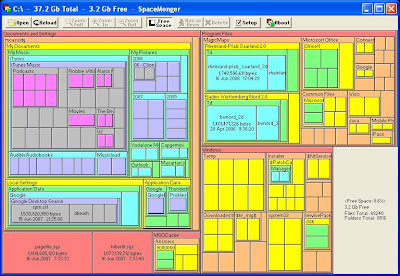
Apparently the author now has a paid version, and for this reason doesn't recommend the old version 1.4, but I found it perfect for my purposes. It's a really lightweight download, just the exe and a readme. You can download it here (note - select tab "Free Software", then scroll down a bit for version 1.4).
I tried it out and got back 3 GB right away from an old PDA GPS Sync software which had not cleanly uninstalled. A screenshot is below...
Apparently the author now has a paid version, and for this reason doesn't recommend the old version 1.4, but I found it perfect for my purposes. It's a really lightweight download, just the exe and a readme. You can download it here (note - select tab "Free Software", then scroll down a bit for version 1.4).
Powered by ScribeFire.
Tuesday, June 12, 2007
Microsoft PowerToy Alt-Tab Replacement

Here's a useful tip from the Lifehacker guys. Normal use of Alt-Tab enables you to switch applications with an icon, so that e.g. 2 instances of Word are indistinguishable. Installing the Microsoft PowerToy Alt-Tab Replacement enables you to see a mini-screenshot of the app window, making the choice easier.
Here's the direct link to the Microsoft Download.
Here's the direct link to the Microsoft Download.
Powered by ScribeFire.
Tuesday, May 22, 2007
British History Timeline
The BBC has a fantastic interactive timeline view of British history here. Take a look around, it's very imformative, starting from 6000 BC (Britain becomes separated from the European mainland) and going up to Dec 2005 (Civil partnerships give same-sex couples legal rights).
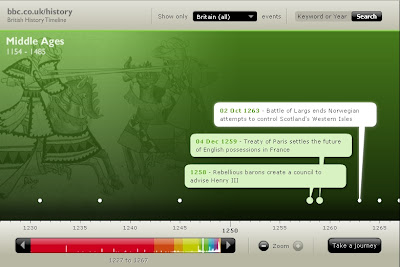
I was especially interested in the 1666-1714 timescale, as this is the time period dealt with in Neal Stephenson's "Baroque Cycle" trilogy, of which I'm currently reading the final book, "The System of the World".
I was especially interested in the 1666-1714 timescale, as this is the time period dealt with in Neal Stephenson's "Baroque Cycle" trilogy, of which I'm currently reading the final book, "The System of the World".
Powered by ScribeFire.
Thursday, May 03, 2007
Hex 09 f9 11 02 9d 74 e3 5b d8 41 56 c5 63 56 88 c0
The hexadecimal number in the title is really quite remarkable. It is a widely distributed example of an AACS "processing key". As noted by Ed Felten on Freedom to Tinker,
I don't own a HD-DVD or Blu-Ray player. I own no HD-DVD or Blu-Ray discs. I have no interest in pirating HD movies. I have no need for this key. However I think that it should remain available. DRM has failed as a technology. Using legal antics to prolong the futility of DRM is of no benefit to consumer or copyright holder. The sooner we move on to more sensible models for digital content distribution the better.
"Together with a suitable computer program, the key allows the decryptionThe AACS Licensing Authority has been desperately trying to eliminate this string from the Internet, by sending out "cease and desist" letters to websites. Their campaign is doomed to failure, because the key is now so widely available that for every desisting site, there are hundreds more who will post it. See the Digg blog for Kevin Rose's explanation of why they're no longer attempting to suppress the publication of "09 F9 11 02 9D 74 E3 5B D8 41 56 C5 63 56 88 C0".
of video content on most existing HD-DVD and Blu-ray discs".
I don't own a HD-DVD or Blu-Ray player. I own no HD-DVD or Blu-Ray discs. I have no interest in pirating HD movies. I have no need for this key. However I think that it should remain available. DRM has failed as a technology. Using legal antics to prolong the futility of DRM is of no benefit to consumer or copyright holder. The sooner we move on to more sensible models for digital content distribution the better.
Powered by ScribeFire.
Friday, April 27, 2007
Gliffy
There are many online Office Apps around at the moment, e.g. Google Docs & Spreadsheets. However I had not yet seen an online app to replace Visio before today.
Then I came across Gliffy. This online drawing tool uses some pretty nifty Macromedia Flash technology to impart the feel of a desktop tool within a browser app. The stencils include Masic Shapes; Flow Chart; UML Shapes;E-R Diagrams; Networks; UI and user-uploaded graphics.
Once drawn, the pictures can be saved as graphics files, embedded in websites and blogs, shared with other collaborators etc.
Here's an example diagram I mocked up...

Not necessarily a work of art, but also not substantially worse than I could have achieved with a Visio installation. Most surprisingly, the tool was very easy and fun to use as well as quite intuitive.
3.5 Stars out of 5.
Then I came across Gliffy. This online drawing tool uses some pretty nifty Macromedia Flash technology to impart the feel of a desktop tool within a browser app. The stencils include Masic Shapes; Flow Chart; UML Shapes;E-R Diagrams; Networks; UI and user-uploaded graphics.
Once drawn, the pictures can be saved as graphics files, embedded in websites and blogs, shared with other collaborators etc.
Here's an example diagram I mocked up...
Not necessarily a work of art, but also not substantially worse than I could have achieved with a Visio installation. Most surprisingly, the tool was very easy and fun to use as well as quite intuitive.
3.5 Stars out of 5.
Powered by ScribeFire.
Thursday, April 26, 2007
Robot Recipes
The Register is reporting about a DIY robot kit, funded by, amongst others, Google, Microsoft and Intel. El Reg sells the story as a high-tech conspiracy to take over our living rooms with self-build cyborgs. In actual fact, the Telepresence Robot Kit (TeRK) project seems rather quaint. There are even a number of Recipes for robots to try out at home.
For example, you can build the Qwerkbot Classic:

or go for the more advance Qwerkbot+:

If anyone builds one of these things, please let me know how it goes.
For example, you can build the Qwerkbot Classic:
or go for the more advance Qwerkbot+:
If anyone builds one of these things, please let me know how it goes.
Powered by ScribeFire.
Subscribe to:
Posts (Atom)


